CAP Theorem
Real Incident: GitHub, October 2018
A 43-second network partition split GitHub's MySQL cluster. Both sides promoted a primary. Two databases accepted writes simultaneously. Result: 24 hours of degraded service, millions of developers affected. This is CAP theorem hitting production.
The 30-Second Explanation
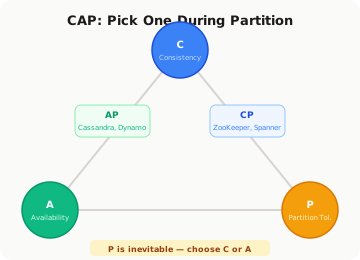
In a distributed system, when a network partition happens, you must choose:
Consistency (CP)
"I'd rather show an error than wrong data"
Banks, inventory, bookings
Availability (AP)
"I'd rather show stale data than nothing"
Social feeds, DNS, shopping carts
The key insight: You're not choosing between C, A, and P. Partitions are inevitable. You're choosing between C and A when a partition happens.
The Pizza Shop Analogy
You own 3 pizza shops in SF, NYC, and Chicago. All must serve the same menu.
The phone lines between shops go down (partition). A customer in Chicago asks for a pizza you just added in SF 5 minutes ago.
| You choose... | What happens | Real-world equivalent |
|---|---|---|
| Consistency | "Sorry, system is down. Come back later." | Banking app during outage |
| Availability | "Here's our menu!" (missing the new pizza) | Netflix showing stale recommendations |
That's it. That's the entire theorem.
What FAANG Interviewers Actually Ask
"Given this system, would you choose CP or AP?"
Framework to answer:
| If the data is... | Choose | Because | Example |
|---|---|---|---|
| Financial / transactional | CP | Wrong balance = lawsuit | Stripe, banks |
| User-generated content | AP | Stale likes > error page | Instagram, Twitter |
| Inventory / booking | CP | Overselling = real money lost | Uber seats, airline tickets |
| Session / preference | AP | Show old settings > force re-login | Netflix, Spotify |
| Leader election / config | CP | Split-brain = catastrophe | ZooKeeper, etcd |
Real Systems Mapped
| System | Choice | What happens during partition |
|---|---|---|
| ZooKeeper | 🔒 CP | Minority side stops accepting writes. Waits for quorum. |
| etcd | 🔒 CP | Raft consensus — no leader = no writes. |
| Google Spanner | 🔒 CP | TrueTime + Paxos. Blocks rather than diverge. |
| Cassandra | 🌐 AP | Every node accepts writes. Resolves conflicts later (last-write-wins). |
| DynamoDB | 🌐 AP | Eventually consistent by default. Strong consistency optional (costs 2x). |
| MongoDB | 🔒 CP | Primary goes down → election (10-30s downtime). Reads can be stale on secondaries. |
PACELC — The Follow-Up They Always Ask
"OK, so you know CAP. What about when there's NO partition?"
PACELC extends CAP: if P**artition → choose **A or C. **E**lse (normal operation) → choose **L**atency or **C**onsistency.
| System | During Partition | Normal Operation |
|---|---|---|
| Cassandra | A (stay available) | L (fast, eventually consistent) |
| DynamoDB | A | L (default) or C (strong reads cost 2x) |
| ZooKeeper | C (refuse writes) | C (always consistent, higher latency) |
| Spanner | C | C (TrueTime makes it fast despite consistency) |
| MongoDB | C | L (reads from secondaries are faster but stale) |
Interview Gold
When an interviewer asks "What's the trade-off of using DynamoDB?" — answer with PACELC: "It's PA/EL by default. Available during partitions, low-latency in normal operation, but eventually consistent. You can opt into strong consistency per-read at 2x cost."
Consistency Models (From Strict to Relaxed)
| Model | Promise | Real-World Feel |
|---|---|---|
| Linearizability | Every read sees the absolute latest write | Your bank balance — always correct |
| Sequential | All nodes agree on ordering, maybe slightly behind | A shared Google Doc |
| Causal | If A caused B, everyone sees A before B | Chat messages in order |
| Eventual | Everyone will eventually agree | Instagram like count (might be off by a few) |
The 3 Interview Mistakes That Get You Rejected
Don't Say These
- "Just pick CP for everything" — Shows you don't understand the trade-off. No interviewer wants a system that goes down during every network blip.
- "CA is a valid option" — In any real distributed system, partitions WILL happen. CA only exists on a single machine (not distributed).
- "Eventual consistency means data loss" — No. It means temporary staleness. All writes are eventually propagated. No data is lost.
Your Interview Answer Template
When asked "How would you handle consistency in [System X]?"
"For [specific use case], I'd choose [CP/AP] because [reason tied to business impact]. During normal operation, I'd optimize for [latency/consistency]. Specifically, I'd use [real system] which gives me [specific guarantee]. For the parts that need [opposite choice], I'd use a separate store — for example [second system] for [that specific data]."
Example: "For the payment service, I'd choose CP using PostgreSQL with synchronous replication — a wrong balance is worse than brief unavailability. But for the activity feed, I'd use Cassandra (AP) because showing a slightly stale feed is fine, and we need sub-10ms reads globally."
Quick Recall Card
| Question | Answer |
|---|---|
| What is CAP? | During a partition, choose Consistency or Availability |
| Why not both? | Partitions are inevitable in distributed systems |
| CP examples? | ZooKeeper, etcd, Spanner, HBase, MongoDB |
| AP examples? | Cassandra, DynamoDB, CouchDB, DNS |
| What's PACELC? | Extends CAP: what do you trade-off when there's NO partition? |
| Most common mistake? | Treating it as "pick 2 of 3" instead of "CP or AP during partition" |
See Also
- Consistent Hashing — Distributing data across nodes evenly
- Distributed Caching — Caching strategies and cache coherence
- Distributed Locks — Coordination in distributed systems
- SQL vs NoSQL — Choosing the right database model
- Database Sharding — Horizontal partitioning strategies
- Consensus Algorithms — Raft, Paxos, and leader election