HTTPS & TLS
Real Incident: Firesheep, 2010
A Firefox extension let anyone on public WiFi hijack Facebook/Twitter sessions with one click. 1.4 million downloads in week one. The message: HTTP is a live broadcast of your digital life. This forced the entire internet to adopt HTTPS.
The 30-Second Explanation
HTTPS = HTTP + TLS encryption. Every byte between client and server is encrypted so nobody in the middle can read or tamper with it.
HTTP (Postcard)
Everyone who handles it can read it. Passwords, cookies, everything.
HTTPS (Sealed Box)
Encrypted end-to-end. Only sender and receiver can read.
TLS Handshake — What Actually Happens
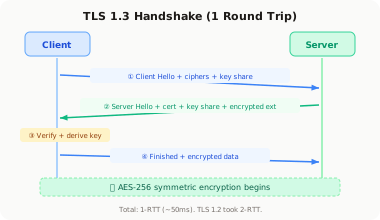
| Step | What | Why |
|---|---|---|
| 1 | Client Hello — "I support TLS 1.3, these ciphers" | Announce capabilities |
| 2 | Server Hello — "Let's use TLS 1.3 with AES-256. Here's my certificate." | Agree on crypto |
| 3 | Client verifies cert — checks CA chain, expiry, domain match | Prove server identity |
| 4 | Key Exchange — Diffie-Hellman to derive shared secret | Both sides get same key without sending it |
| 5 | Encrypted traffic begins — symmetric encryption (AES) | Fast, secure communication |
Total time: TLS 1.3 = 1 round trip (1-RTT). TLS 1.2 = 2 round trips. Resumption = 0-RTT.
The 3 Guarantees
| Guarantee | What | Without It |
|---|---|---|
| Confidentiality | Nobody can read the data | Passwords visible on WiFi |
| Integrity | Nobody can modify data in transit | Attacker injects malware into page |
| Authentication | You're talking to the real server | Attacker impersonates your bank |
Symmetric vs. Asymmetric — Why Both?
| Type | Speed | Used For |
|---|---|---|
| Asymmetric (RSA/ECDSA) | Slow (1000x slower) | Key exchange + authentication (handshake only) |
| Symmetric (AES-256) | Fast | All actual data transfer after handshake |
Why both? Asymmetric solves the "how do two strangers agree on a secret key?" problem. Once they have the shared key, symmetric takes over because it's 1000x faster.
Certificates — The Trust Chain
| Concept | What |
|---|---|
| Certificate | Server's public key + domain + who issued it |
| CA (Certificate Authority) | Trusted third party that signs certificates (DigiCert, Let's Encrypt) |
| Chain of trust | Root CA → Intermediate CA → Server cert |
| Validation | Browser checks: is this cert for this domain? Signed by trusted CA? Not expired? |
Let's Encrypt made HTTPS free. Before 2015, certificates cost $100-300/year. Now there's no excuse for HTTP.
TLS 1.2 vs TLS 1.3
| Aspect | TLS 1.2 | TLS 1.3 |
|---|---|---|
| Handshake | 2-RTT | 1-RTT (50% faster) |
| Resumption | 1-RTT | 0-RTT (instant) |
| Ciphers | Many (some weak) | Only strong ones kept |
| Forward secrecy | Optional | Mandatory |
| Adopted | 2008 | 2018 |
mTLS — When the Server Also Verifies the Client
| Normal TLS | mTLS (Mutual TLS) |
|---|---|
| Client verifies server | Both verify each other |
| Browser → Website | Service A → Service B (microservices) |
| One certificate | Two certificates |
| "Is this really Google?" | "Is this really the payment service calling me?" |
Used in: Service mesh (Istio), internal microservice communication, zero-trust networks.
What Interviewers Ask
| Question | Key Point |
|---|---|
| "How does HTTPS work?" | Asymmetric for key exchange → symmetric for data |
| "What's a certificate?" | Public key + identity, signed by trusted CA |
| "Why not just asymmetric for everything?" | Too slow (1000x slower than symmetric) |
| "What's forward secrecy?" | Compromising today's key doesn't decrypt past traffic (ephemeral DH keys) |
| "HTTP/2 vs HTTP/3?" | H2 = multiplexed over TCP+TLS. H3 = QUIC (UDP+TLS built-in, 0-RTT) |
| "What's certificate pinning?" | Client hardcodes expected cert/key. Prevents CA compromise. Used in mobile apps. |
Real-World Numbers
| Metric | Value |
|---|---|
| HTTPS adoption (2024) | 95%+ of web traffic |
| TLS handshake overhead | 1-2ms (TLS 1.3) |
| Certificate cost | Free (Let's Encrypt) |
| HTTP/3 adoption | 30%+ (Google, Cloudflare, Meta) |
The 3 Mistakes That Get You Rejected
Don't Say These
- "HTTPS uses RSA to encrypt all traffic" — RSA is only for the handshake. Actual data uses AES (symmetric). If you encrypt GB of data with RSA, you'll be waiting all day.
- "The certificate contains the private key" — NEVER. The cert has the PUBLIC key. The private key never leaves the server.
- "HTTPS prevents all attacks" — It prevents eavesdropping and tampering, but NOT: XSS, SQL injection, DDoS, or phishing with a valid cert.
Quick Recall Card
| Question | Answer |
|---|---|
| What does TLS guarantee? | Confidentiality, Integrity, Authentication |
| Handshake uses? | Asymmetric (RSA/ECDH) for key exchange |
| Data transfer uses? | Symmetric (AES-256) for speed |
| TLS 1.3 improvement? | 1-RTT handshake, 0-RTT resumption, mandatory forward secrecy |
| What's mTLS? | Both client and server authenticate each other |
| What's forward secrecy? | Ephemeral keys — past traffic safe even if long-term key leaks |