Load Balancing
Real Incident: Reddit, 2023
A single misconfigured load balancer rule sent 80% of traffic to 2 of 50 servers. Those 2 servers melted. Cascading failure brought down all of Reddit for 3 hours. Load balancing isn't just "spread traffic evenly" — it's the difference between staying up and going dark.
The 30-Second Explanation
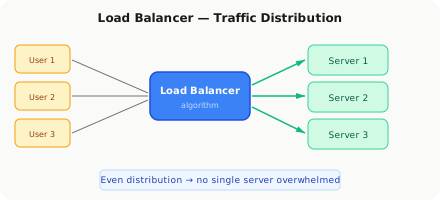
Load balancer = a traffic cop that distributes incoming requests across multiple servers so no single server gets overwhelmed.
Performance
Spread load → lower latency per request
Availability
Server dies → LB routes around it
Scalability
Add servers → handle more traffic
The Restaurant Analogy
You own a restaurant with 5 chefs. Customers line up at the door.
| Strategy | What the host does | Real equivalent |
|---|---|---|
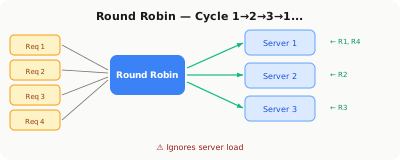
| Round Robin | Customer 1 → chef 1, customer 2 → chef 2... repeats | Nginx default |
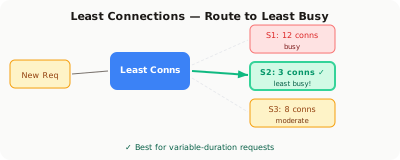
| Least Connections | "Which chef has fewest orders right now?" | HAProxy for APIs |
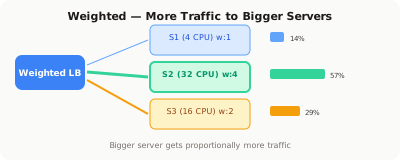
| Weighted | "Chef 3 is 2x fast — send double orders" | Mixed hardware |
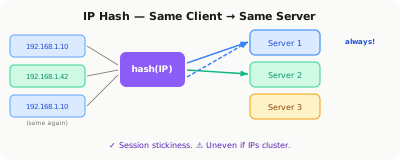
| IP Hash | "You always sit at chef 2's counter" | Session affinity |
| Random Two Choices | Pick 2 chefs, send to less busy one | Netflix (power of 2) |
Algorithms in Detail
Round Robin
Least Connections
Weighted Round Robin
IP Hash (Sticky Sessions)
Algorithm Comparison
Static (Don't check server state)
| Algorithm | How | Best For | Weakness |
|---|---|---|---|
| Round Robin | Cycle through servers | Equal-capacity, stateless | Ignores server load |
| Weighted Round Robin | More requests to higher-weight servers | Mixed hardware | Weights don't adapt |
| IP Hash | hash(client_IP) % N | Session stickiness | Uneven if IPs cluster |
| URL Hash | hash(URL) % N | Cache efficiency | Hot URLs = hot servers |
Dynamic (React to real-time state)
| Algorithm | How | Best For | Weakness |
|---|---|---|---|
| Least Connections | Route to server with fewest active conns | WebSocket, long requests | Doesn't weight request cost |
| Least Response Time | Route to fastest-responding server | Latency-sensitive APIs | Needs health probes |
| Random Two Choices | Pick 2 random, choose less loaded | Large clusters (100+) | Slightly more logic |
Interview Gold
"Power of Two Choices" is used at Netflix. Picks 2 random servers and routes to the less loaded one. Avoids the herd effect where all clients pile onto the same "least loaded" server simultaneously. Near-optimal distribution with minimal state.
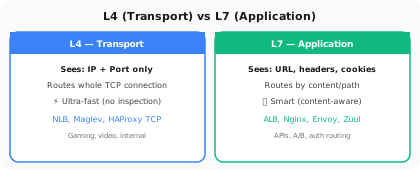
L4 vs L7 — The Core Distinction
| L4 (Transport) | L7 (Application) | |
|---|---|---|
| Sees | IP + Port only | HTTP headers, URL, cookies, body |
| Speed | Faster (no payload inspection) | Slower (parses HTTP) |
| TLS | Passes through | Terminates (can inspect) |
| Routing | By connection | By URL, header, cookie |
| Use case | Network edge, gaming, streaming | API gateway, A/B testing, auth routing |
Health Checks
| Type | How | When |
|---|---|---|
| Passive | Track 5xx responses. 3 failures in 30s = unhealthy | Every request (free) |
| Active | GET /health every 5s. No response in 2s = unhealthy | Periodic |
| Deep | Check DB, cache, queue connectivity | Less frequent (30s) |
Key concepts:
- Draining: Stop new requests, finish existing ones (graceful removal)
- Circuit breaker: Unhealthy? Remove immediately. Re-add after 3 consecutive passes.
The LB is a SPOF — Now What?
| Solution | How |
|---|---|
| Active-Passive | Two LBs. Passive watches heartbeat. Primary dies → passive takes VIP. |
| Active-Active | Both serve traffic. DNS returns both IPs. Either handles full load. |
| DNS-level | Multiple A records. Client picks one. No single LB bottleneck. |
Real Systems
| Company | Stack | Notable |
|---|---|---|
| Maglev (L4) + Envoy (L7) | Maglev: 10M+ packets/sec per machine | |
| Netflix | Zuul (L7) + Eureka (discovery) | Power of two choices algorithm |
| AWS | ALB (L7) + NLB (L4) | ALB does content-based routing |
| Uber | Custom L7 with ring routing | Routes by city for data locality |
| Cloudflare | Anycast + Unimog (L4) | Seamless traffic shifting between DCs |
Global Load Balancing
| Method | How | Example |
|---|---|---|
| GeoDNS | DNS returns IP of nearest region | Route53 geolocation |
| Anycast | Same IP from multiple locations, BGP routes to nearest | Cloudflare (1.1.1.1) |
| GSLB | Health-aware GeoDNS | F5, Akamai GTM |
The 3 Mistakes That Get You Rejected
Don't Say These
- "Round robin is always fine" — If servers have different capacity or requests have different cost, round robin creates hotspots. You need weighted or dynamic algorithms.
- "The load balancer can't fail" — It absolutely can. Always discuss LB high availability (active-active, DNS failover).
- "Just use sticky sessions for everything" — Sticky sessions kill load balancing effectiveness and make scaling painful. Use stateless services + external session store instead.
Interview Answer Template
"For [system], I'd use [L4/L7] load balancing with [algorithm] because [reason]. Health checking: passive monitoring (5xx tracking) + active probes to /health every [N]s. LB HA: [active-active/passive] with [mechanism]. Global: [GeoDNS/Anycast] for multi-region routing."
Quick Recall Card
| Question | Answer |
|---|---|
| L4 vs L7? | L4 = fast, dumb (IP/port). L7 = slower, smart (HTTP-aware) |
| Best default algorithm? | Least Connections (adapts to real load) |
| Best at massive scale? | Power of Two Choices (minimal state, near-optimal) |
| How to avoid LB SPOF? | Active-Active LBs or DNS-level redundancy |
| Sticky sessions how? | IP hash, cookie-based, or header-based |
| Health check types? | Passive (errors), Active (poll), Deep (deps) |