Database Sharding
Real Incident: Instagram, 2012
Instagram hit 25M users on a single PostgreSQL instance. Write throughput maxed at 15K TPS. Vertical scaling hit $30K/month EC2 ceiling. They sharded by user_id — each shard holds a range of users. Scaled to 2B+ accounts. Every large-scale system eventually shards. The question isn't IF but WHEN and HOW.
Why This Comes Up in Every Design Interview
When you say "I'll use PostgreSQL" in an interview, the natural follow-up is: "What happens at 100M users? 1B rows? 50K writes/sec?" The answer is sharding. Interviewers specifically test:
- Can you identify WHEN to shard (not too early, not too late)
- Can you choose a shard key that avoids hotspots
- Do you understand the problems sharding creates (joins, transactions, resharding)
- Can you reason about alternatives before jumping to sharding
The Scaling Staircase — Shard LAST, Not First
| Stage | Strategy | Handles | Cost |
|---|---|---|---|
| 1 | Optimize queries + indexes | 10x current load | Free |
| 2 | Vertical scaling (bigger machine) | Up to ~$50K/month instance | Money |
| 3 | Read replicas (write to primary, read from replicas) | 5-10x read throughput | Replication lag complexity |
| 4 | Caching (Redis/Memcached in front of DB) | 100x read throughput | Cache invalidation |
| 5 | Table partitioning (within single instance) | Larger data, faster queries | DB-managed, limited |
| 6 | Sharding (data across multiple instances) | Near-unlimited scale | Significant complexity |
Interview gold: "I'd exhaust vertical scaling, read replicas, and caching before sharding. Sharding adds enormous complexity — cross-shard queries, distributed transactions, resharding operations. But when a single machine can't handle the write throughput or data volume, it's the only option."
Back-of-Envelope: When to Shard
PostgreSQL practical limits on a single instance (~$20K/month machine):
| Resource | Practical Limit | Warning Sign |
|---|---|---|
| Table size | ~1-5 TB | Queries slow, vacuum takes hours |
| Write TPS | ~20-50K TPS | Write latency increasing |
| Connections | ~500-1000 | Connection pool exhaustion |
| Storage IOPS | ~50K IOPS (NVMe) | I/O wait increasing |
Example calculation: Social media platform, 500M users, 5 posts/user/day:
| Metric | Value | Calculation |
|---|---|---|
| Daily posts | 2.5B | 500M × 5 |
| Writes/sec | ~29K | 2.5B / 86400 |
| Peak writes/sec (10x) | ~290K | Well beyond single-instance |
| Storage/year | ~25 TB | 2.5B × 365 × ~30 bytes per row |
| Verdict | Must shard | Single instance maxes at ~50K writes/sec |
Choosing a Shard Key (The Most Critical Decision)
The shard key determines everything: query routing, data distribution, hotspot risk. Once chosen, it's extremely expensive to change.
Properties of a good shard key:
| Property | Why | Example |
|---|---|---|
| High cardinality | Even distribution across many shards | user_id (millions of values) |
| Even distribution | No shard gets disproportionate load | UUID > sequential ID (sequential causes write hotspot on latest shard) |
| Matches access pattern | Queries hit one shard, not all | Shard by user_id if most queries are per-user |
| Immutable | Key change = data movement | user_id (never changes) > email (can change) |
| Not correlated with time | Avoids "hot newest shard" | Hash of user_id > creation_date |
How to evaluate a shard key — the scatter/gather test:
- "What % of my queries can be answered by a single shard?"
- Target: >95% single-shard queries
- If most queries need ALL shards (scatter-gather), your key is wrong
Sharding Strategies Compared
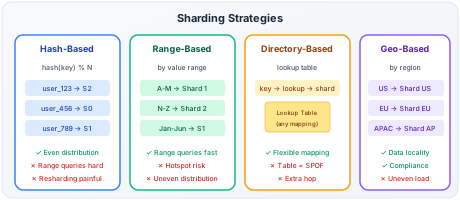
Hash-Based Sharding
| Pros | Cons |
|---|---|
| Even distribution | Range queries impossible (scan all shards) |
| Simple routing | Adding shards = rehash everything (unless consistent hashing) |
| No hotspots (with good hash) | Can't colocate related data |
When: Even distribution is priority, access is by primary key.
Range-Based Sharding
| Pros | Cons |
|---|---|
| Range queries efficient | Hotspot on "active range" (newest users) |
| Easy to understand | Uneven distribution over time |
| Can add shards for new ranges | Requires manual rebalancing |
When: Data is naturally ordered and range queries are important (time-series, analytics).
Directory-Based Sharding
| Key | Shard |
|---|---|
| user_1 - user_500K | shard_1 |
| user_500K - user_1.2M | shard_2 |
| user_1.2M - user_3M | shard_3 |
| Pros | Cons |
|---|---|
| Flexible mapping (any logic) | Directory = SPOF + bottleneck |
| Easy rebalancing | Extra network hop for lookup |
| Handles uneven data | Directory must be cached/replicated |
When: Need flexibility, or combining strategies (move hot users to dedicated shards).
Compound Shard Keys (DynamoDB Pattern)
Problem: You need both even distribution AND range queries within an entity.
Solution: Compound key = Partition Key (hash distribution) + Sort Key (range within partition)
| Example | Partition Key | Sort Key | Query Pattern |
|---|---|---|---|
| User's posts | user_id | timestamp | "All posts by user in date range" |
| Order items | order_id | item_id | "All items in an order" |
| Chat messages | conversation_id | message_timestamp | "Recent messages in conversation" |
Why this works: All data for one entity (user, order, conversation) lives on the same shard. Range queries work within-shard. No scatter-gather needed.
The Hard Problems Sharding Creates
1. Cross-Shard Queries (Scatter-Gather)
Problem: "Show all orders over $100 across all users"
- Must query EVERY shard, merge results
- Latency = slowest shard
- Can't use DB-level sorting/pagination across shards
Mitigations:
- Denormalize: duplicate data to enable single-shard queries
- Secondary index service: Elasticsearch indexes all data for complex queries
- Materialized views: Pre-compute aggregates
2. Cross-Shard Transactions
Problem: Transfer money from user on Shard 1 to user on Shard 3
- No single DB transaction spans shards
- Need distributed transaction (2PC) or eventual consistency
Mitigations:
| Approach | How | Trade-off |
|---|---|---|
| Two-Phase Commit (2PC) | Coordinator asks all shards to prepare, then commit | Slow, blocks on failures |
| Saga pattern | Sequence of local transactions + compensations | Eventually consistent, complex |
| Co-locate | Put related data on same shard | Limits flexibility |
3. Resharding (Adding Shards)
Problem: Started with 10 shards, now need 20. With hash % N, ALL keys remap.
Solutions:
| Strategy | How | Downtime |
|---|---|---|
| Consistent hashing | Only 1/N keys move | Minimal |
| Logical shards | Create 1000 logical shards, map to physical. Remap = move logical shards. | Minutes |
| Double-write migration | Write to old + new, read from new once caught up | Zero downtime |
| Vitess/ProxySQL | Middleware handles resharding transparently | Application unaware |
4. Unique Constraints Across Shards
Problem: "Email must be unique globally" but data is on different shards.
Solutions:
- Global unique index (separate service/table)
- Shard by the unique field (email)
- UUIDs instead of sequences (guaranteed unique without coordination)
- Snowflake IDs (Twitter): timestamp + machine_id + sequence = unique + sortable
5. JOINs Across Shards
Problem: SELECT * FROM orders JOIN users ON... when orders and users on different shards.
Solutions:
- Denormalize: Store user_name in orders table (duplicate data)
- Application-level join: Fetch from both shards, join in code
- Co-locate: Shard orders by user_id too (same shard)
- Separate analytics DB: ETL into data warehouse for complex queries
Real-World Sharding Examples
| Company | Strategy | Shard Key | Details |
|---|---|---|---|
| Hash (pgbouncer + custom) | user_id | Logical shards → physical mapping | |
| Uber | Geo + hash | city_id | Trips sharded by city for locality |
| Stripe | Directory | merchant_id | Hot merchants on dedicated shards |
| Discord | Hash (Cassandra) | guild_id | Messages sharded per guild |
| Vitess (YouTube) | Hash (MySQL) | Configurable keyspace | Middleware manages sharding transparently |
| Hash (MySQL) | object_id | 8192 logical shards, ~100 physical | |
| Hash (MySQL + TAO) | user_id | Thousands of shards, custom routing |
Logical vs Physical Shards (Pinterest/Uber Pattern)
The trick: Don't map keys directly to physical machines. Add an indirection layer.
Step 1: key → logical_shard_id (hash % 8192)
Step 2: logical_shard_id → physical_machine (lookup table)
Why:
- Start with 8192 logical shards on 4 physical machines (2048 logical per physical)
- Need more capacity? Move 1024 logical shards to a new machine
- No key remapping, no data copying logic change
- Just update the mapping table
Pinterest's approach: Started with 8192 logical shards. Currently mapped to ~150 physical database instances. Never needed to rehash.
Interview Framework
When the interviewer asks about scaling your database:
Step 1 — Delay sharding: "First I'd add read replicas for read-heavy queries and a cache layer. This gets us to [X] scale without sharding complexity."
Step 2 — When to shard: "Once we exceed [single-machine write capacity / storage], I'd introduce sharding. For this system, that's around [Y] users / [Z] writes/sec."
Step 3 — Shard key choice: "I'd shard by [user_id/merchant_id/entity_id] because [95%+ of queries are per-entity, it's immutable, high cardinality, evenly distributed]."
Step 4 — Strategy: "I'd use [hash-based with consistent hashing / logical shards mapped to physical] so resharding doesn't require data rehashing."
Step 5 — Address hard problems: "For cross-shard queries, I'd [denormalize / use Elasticsearch]. For distributed transactions, I'd use the [saga pattern / co-locate]. For unique constraints, [global index / UUID]."
Quick Recall
| Question | Answer |
|---|---|
| When to shard? | After exhausting vertical scaling + read replicas + caching |
| Best shard key properties? | High cardinality, even distribution, matches access pattern, immutable |
| Scatter-gather test? | >95% queries should hit single shard |
| Hash vs range? | Hash = even distribution. Range = efficient range queries. |
| Resharding without downtime? | Logical shard indirection OR consistent hashing |
| Cross-shard joins? | Denormalize, co-locate, or separate analytics service |
| Unique constraints across shards? | Global unique index, UUID, or shard by the unique field |
| Pinterest pattern? | 8192 logical shards → N physical machines. Remap mapping, not data. |